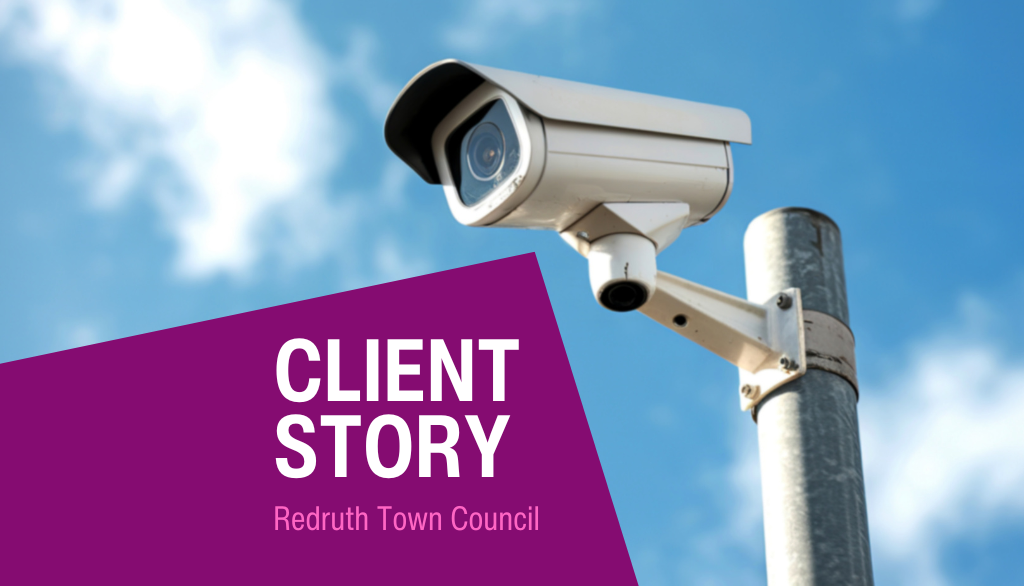
When Cornwall Council announced it would cease operating its CCTV monitoring service, local councils faced a significant challenge: how to maintain an important community safety resource while continuing to deliver value for money for local taxpayers. Rather than accept an externally managed solution, Redruth Town Council took the lead in developing a new approach.
Leading from the Front
At the heart of the project was Redruth Town Council and its Town Clerk, Charlotte Williams, who recognised both the challenge and the opportunity. Working collaboratively with neighbouring councils, she helped develop a new CCTV partnership that has created a flexible, locally managed model for community safety in Cornwall.
For Charlotte and Redruth Town Council, doing nothing was never an option. She, along with her colleagues, was vocal on the role that CCTV plays in supporting community safety, assisting the police, and helping to tackle anti-social behaviour. Keenly aware of the financial pressures faced by local authorities, councillors were determined to ensure residents continued to benefit from an effective monitoring system while maintaining control over both costs and service quality.
Rather than rely on a single commercial provider, Charlotte and her team explored what a new model could look like – one built from the ground up. Their ambition was to create a service that delivered flexibility, value for money and, most importantly, accountability to the communities it served.
As discussions progressed, it became clear that collaboration would be key to success.
Collaboration
To make the proposal viable, a group of like-minded local authorities with shared concerns and objectives came together. Truro City Council, Camborne Town Council and Perranzabuloe Parish Council joined the initiative.
Working together, the councils developed a shared approach to CCTV monitoring and community safety, allowing resources, expertise and costs to be shared across multiple organisations. This led to the creation of a new CCTV operations room based in Redruth, providing monitoring and recording services on behalf of all four participating councils.
Establishing the new service required significant planning, investment, and coordination. Infrastructure had to be upgraded, specialist equipment installed, and dedicated monitoring staff recruited and trained. Existing camera networks were reviewed to ensure they could support the new operational model.
What began as an ambitious idea took almost a year to develop into a fully functioning service, providing monitoring and recording support on behalf of all four participating councils.
Starting Anew
There was no existing blueprint to follow. Redruth Town Council was stepping into an area that required significant technical knowledge, operational expertise and an understanding of complex regulatory requirements. Keeping local communities safe needed more than cameras, monitors, and operators.
Dedicated CCTV operators had to be appropriately licensed and trained, while systems and procedures were established to support police requests for footage and evidence gathering. Given the nature of Cornwall’s economy, the service was also designed to respond to the varying needs of participating councils, allowing monitoring patterns to reflect local events, seasonal activity, and periods of increased demand.
Close working relationships were built with police officers, community safety teams, Business Improvement Districts and town centre marshals, creating a more connected approach to tackling anti-social behaviour and supporting safer town centres. Alongside the operational benefits, the project also strengthened relationships between the participating councils.
“There’s a much stronger collaboration between the four councils than there ever was,” explains Charlotte. “I think that’s got to be beneficial in terms of economies of scale going forwards.”
A Learning Journey
One of the most important aspects of the project was the level of governance and compliance required.
As the initiative took shape, the council teams had to navigate a complex landscape of data protection legislation, information management obligations, and operational procedures. CCTV monitoring requires strict compliance with statutory obligations, safeguarding responsibilities, police protocols and relevant codes of practice. Each aspect of the system required careful scrutiny, including arrangements for managing data-related requests including Data Subject Access Requests and Freedom of Information requests.
The process proved to be an eye-opening experience.
Charlotte said:
“I think it heightened our awareness of our role as data controller and processor of information. We’ve all been on a learning journey, but that’s good because it means we’ve now looked at overhauling other policies in our day-to-day operations.”
Lessons learned through the project extended well beyond CCTV monitoring. Reviewing policies, strengthening procedures, and embedding best practice helped improve governance across all the participating councils.
Specialist Support
Creating a shared CCTV service involved far more than operational planning. The partnership needed a robust legal and governance framework that would enable multiple councils to work together while meeting complex regulatory, data protection and information-sharing requirements.
To help establish these foundations, Redruth Town Council sought specialist legal support.
Having already worked with Stephens Scown on a variety of matters, including property and employment-related support through the firm’s HRExpress service, the council turned to Stephens Scown’s Intellectual Property and Data Protection and Corporate specialists for assistance.
As Charlotte says, “Keeping people safe is the driver, and security is paramount.”
Leanne Yendell and Thomas Chartres-Moore from the Intellectual Property and Data Protection team worked alongside Tim Lane from the Corporate team, helping the councils establish the agreements, policies and procedural documentation required to operate the service effectively while maintaining legal compliance.
Regular meetings with representatives from all four councils ensured operational, governance and compliance requirements were considered from the beginning. Focus was placed on partnership structures, data protection obligations, information-sharing protocols, and access arrangements.
Reflecting on Stephens Scown’s support, Charlotte said:
“I felt very handheld through the whole process. I always felt that there’s somebody at the end of the phone. It’s been very professional, with real attention to detail and a brilliant team to work with. They were very responsive and delivered a gold standard service.”
While the work required investment from Redruth Town Council, there was a clear recognition that establishing strong foundations from the outset would help ensure the service could grow and continue delivering value to local communities.
Looking Ahead
The CCTV project may still be in its preliminary stages, but it has already attracted interest from further afield.
The project has attracted interest from other councils and organisations interested in becoming part of the partnership. Thanks to the framework established at the outset, the model has been designed with growth in mind, allowing new partners to join while maintaining consistent governance, operational standards, and community-focused objectives.
Looking to the future, ambitions include increasing resilience through the recruitment of additional operators and expanding the partnership to benefit more communities across Cornwall. Additional funding from the Office of the Police and Crime Commissioner is also helping to enhance the control room’s capabilities and prepare the service for future growth.
A Model for the Future
For Redruth Town Council, the project demonstrates what can be achieved when organisations work together to address a common challenge.
Through Charlotte’s leadership, neighbouring authorities have been brought together around a shared vision for community safety, supported by a governance framework capable of adapting as the partnership grows.
What began as a response to the loss of an existing service has evolved into a collaborative model that is attracting interest from across Cornwall. By combining local accountability, shared resources and strong governance, the partnership provides a blueprint for how councils can work together to deliver value for money while supporting safer communities.
The project stands as an example of the power of collaboration, demonstrating how proactive leadership and a willingness to innovate can create lasting benefits for the people and places local councils serve.