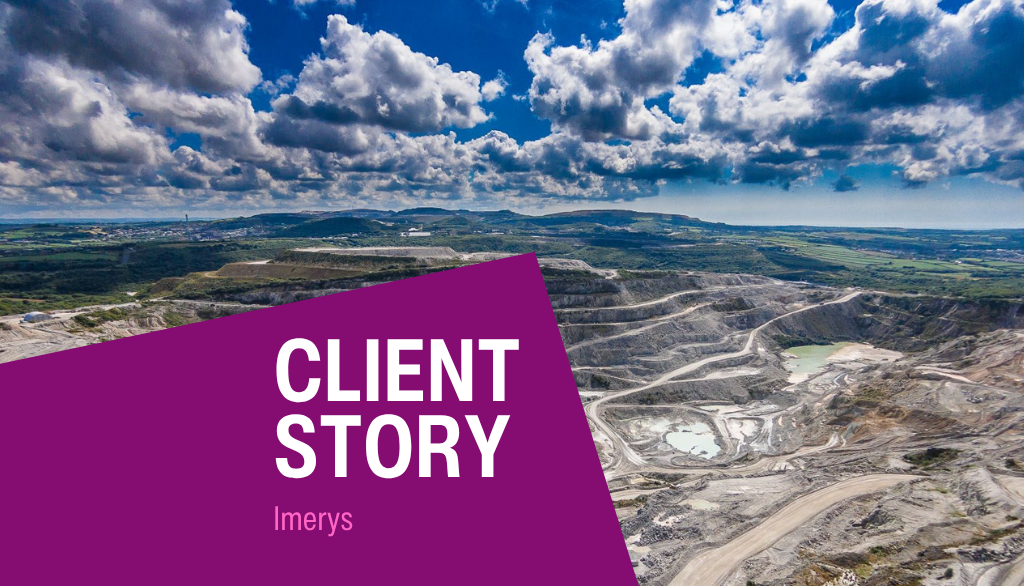
With over 30 operations in the UK and around 1,000 employees, Imerys has a rich, deep history in this country.
China clay mining in Cornwall stretches back 280 years, with Imerys at the helm for the last 25. Cornish kaolin still has decades of reserves and is in high demand across the globe – cementing Imerys’ place in Cornwall for years to come.
About Imerys
Alongside its UK presence, Imerys is a true global leader in its sector. Working in 40 countries across five continents, the company employs more than 12,000 people worldwide, with revenue of £3.1billion, and ownership of thousands of hectares of land. Across its sites in Cornwall, Devon, Dorset, Staffordshire, Yorkshire, and Essex, Imerys produces material used for a broad range of industries. Kaolin, ball clay, calcium carbonate and calcium aluminates are used in everything from ceramics to paints, refractories and hydraulic binders.
From its state-of-the-art Technology Centre in Cornwall, Imerys is a key player in the local economy. With an annual production of around 700,000 tonnes of kaolin and ball clay, the employer’s value to the local community is approximately £40 million annually.
Given the scale of operations and land use, Peter Larwood, mineral planning and development surveyor, plays a crucial role in day to day operations. His time is split between planning and real estate. He is also involved in the sale of land and leases to tenants and landlords, where former mining land is made available for use by others within the community.
However the majority of Peter’s time is spent on mineral planning. Given the nature of Cornwall’s mining history and composition of the land, some of that planning advice is in relation to ROMPs – Review of Old Mineral Permissions. In planning law, it’s a process which involves reviewing historical mineral planning permissions granted long before modern environmental standards existed and updating them with consideration to current conditions for factors such as noise and emissions. The aim is to modernise mineral extraction operations, bringing them in line with today’s environmental and operational best practices.
It’s believed that St Austell’s china clay area is one of the largest ROMPs in the UK. It makes planning a challenge, with more than a hundred original planning permissions, many of which date back to a period from 1940-1960. The goal is to amalgamate those disparate permissions into a single overarching one. Otherwise, each pit has its own operational area, and a working and restoration scheme would need to be submitted for every individual area.
The ROMPs are then subject to review every 15 years, and Imerys is currently within the review cycle stage with Cornwall Council, which is the mineral planning authority for the county. Peter currently has a scoping request with the council, which will be used to consult with statutory bodies such as Natural England, the Environment Agency, and others. Comments received will be used to produce a scoping opinion. It is this document which will dictate what Peter and Imerys will have to include in their environmental impact assessment as part of the review. It’s a lengthy process in terms of agreeing the position, primarily due to the requirement to refer to external bodies.
Legal support for the work in this area comes via Chris Tofts, partner in Stephens Scown’s planning team. Chris has been working with Imerys since 2012, covering hundreds of mineral provisions in that time. He undertakes work on planning permissions and the environmental permits required, for all the sites across which Imerys operates.
Environmental Protection & Land Sales
The standard image of the mining industry is of one that would seem to go against the idea of environmental protection. However, as part of its work, Imerys undertakes work to protect the areas in which it operates.
One such example is at Povington – a ball clay site in Dorset. The pit is located close to an MOD firing range, which means lots of interaction between the two organisations. Imerys wanted to extend the pit, with the extension providing a further decade of life. The planning application was a long process, as the surrounding area is relatively untouched due to MOD restrictions. Part of the planning application was to improve the area. Peter said, “We’ve been consulting with Dorset Council and Natural England and their natural environment team for several years to come up with a suitable scheme. As part of that scheme, we will be providing about 20 hectares of off-site compensation and mitigation land, so we’ll be enhancing the quality of some woodland.
“It’s currently in very poor condition, and we’ll be improving that condition to benefit some of the protected species such as bats and pine martens, which have only recently been reintroduced to the UK. It’ll make a nice habitat for those protected species.”
As the planning system has evolved, there is a lot of focus on biodiversity net gain. While Imerys is restricted in where it can operate by what’s in the ground, one of the starting points when planning what a potential quarry or pit might look like is to come up with a restoration scheme. The new biodiversity net gain requirement for developers means they have to demonstrate a 10% net gain in terms of biodiversity for any project. It can present a challenge to the likes of Imerys because of the timescales involved in developing mining or quarry sites.
What form that restoration can take varies depending on the site, as Peter explains. “For example, lakes are created because you’re digging material out of the ground and there’s going to be a net decrease in the amount of material there. We would look to design around what types of habitats fit the landscape.”
Another example is around the china clay areas of Cornwall, where heathland features heavily. As part of the work, Imerys recreates the habitat, which is limited across other parts of the UK. Peter adds, “There is a real strong focus in terms of responsible mining, both from an environmental point of view, and also a social perspective. We have a lot of support from local residents, but we also want to provide additional facilities for them, such as additional areas for them to walk with permissive rights of way.
“I think it’s very important to us in designing any new project that there’s a focus on not wanting to have a significant impact as a result of the new mine, and we want the benefits to be felt locally as well.”
With the amount of land owned by the company, each year Imerys will identify areas that are non-operational and without mineral interest, which are sold as surplus to requirements. Around five to ten such sites are made available each year.
Sam Dunstan, from Stephens Scown’s specialist mining, minerals and woodlands team, plays a key role in this aspect of Imerys’ work. Selling the non-operational and primarily commercial land, it might be used for a handful of residential housing, for amenities, or as grazing land. Sam has been working with Imerys since starting as a trainee with Stephens Scown in 2018, testament to the long relationship between the two companies.
While the land may not have any mineral value, Imerys will retain certain rights when selling. As Peter explains, “We’d retain the right to either lay pipes, cables, or wires, or have the ability to access the land for maintenance if there are utilities within that area. And if, for example, in ten years’ time, a new mineral is discovered and we work out that the land we sold had that mineral, we retain the rights to work that land, paying suitable compensation to the service owner.”
Peter speaks in glowing terms about the relationship between himself and the teams and individuals within Stephens Scown. “They will always give us advice; there’s no withholding of information until fees and other matters have been agreed. It’s very efficient, very flexible and user friendly, it’s just a positive experience.
“Having resources like Chris Tofts (from the Planning team), who stays up to date with planning reform, and is able to inform on even the minor details is great. It’s always good to attend the quarterly webinars where you can come down and go through the latest updates to the legislation, which is always useful.”
Another example of former Imerys land being used for alternative purposes can be found at the new West Carclaze Garden Village. The lakeside community residential development is built around the China clay landscape of St Austell. With 500 acres of land, 1,500 energy efficient homes, five lakes, schools and amenities, the development is one of the first new Garden Villages in a generation.
Simon Trahair-Davies, partner at Stephens Scown and head of its mining and minerals team, was heavily involved in helping with the legal details around the project. As a former in-house counsel at Imerys, his knowledge was invaluable in supporting Imerys throughout the process. Simon Gawler, a fellow partner in the mining and minerals team has also worked with Imerys as part of the specialist support available thanks to the expertise in this specific sector.
Not only that, but Imerys’ SustainAgility programme, mapping the sustainability of all business activities to allow for better business and investment decisions, further helping improve the environmental impact of its work. Coupled with the company’s EcoVadis certification, a sustainability rating that evaluates the corporate social responsibility performance of an organisation, it’s clear that Imerys places environmental welfare at the heart of its operations. Working with Stephens Scown, which is itself B Corp™ certified, it’s a partnership between companies that share similar values on environmental protection and being a force for good.
Future Focus
The work done by Imerys ensures that it’s not a company that will ever stand still. As Peter says, “There are a lot of areas within Cornwall that Imerys is looking to develop, so it’s going to be a lot of work in the future from a planning and environmental perspective.
“We’re preparing a planning application for an extension at another quarry, obviously we have the ROMP review as well – with the scoping opinion due to be issued at the end of this year. That will start the clock in terms of us preparing the Environmental Impact Assessment for the ROMP review. There are also potential extensions within the China clay area that we could be working on over the next one to five years, so there are several projects on the horizon.
“We’re advised by our mine planners and geologists in terms of what additional minerals we need to access for business continuity.”
Stephens Scown’s corporate team also continues to provide regular corporate transactional, advisory and commercial support to Imerys, working closely with their in-house team in Paris, assisting with regular English law queries, and assistance with larger corporate transactional and commercial contacts. The work is led by partner Laurie Trounce, alongside associate solicitor Olivia Miller, who is fluent in French, ensuring a good working relationship across the border.
With a clear vision for the future, and no sign of demand for its products diminishing, Imerys is well placed to meet the needs of the UK with its continued production and output of materials. Balanced alongside the company’s environmental work, Imerys demonstrates that profit doesn’t have to come at the cost of sustainability. As a B Corp™ law firm that is also committed to maintaining high social and environmental standards in combination with extensive legal expertise in the mining and minerals sector, Stephens Scown is the perfect partner to support Imerys with its various legal and regulatory needs and looks forward to many more years working together.