Employee Ownership is a growing business ownership model which, for some business owners and businesses, can be the right option for a variety of reasons. In this new series, we speak with members of our Employee Ownership team to share insights on the ownership model and how they came to be involved with it.
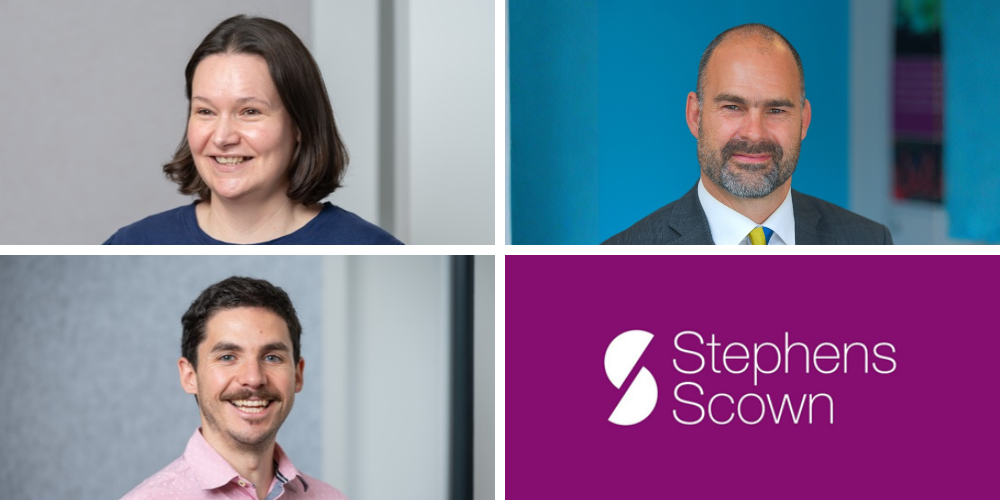
In this edition we hear from three of our advisors:
- Cat Carlton, Partner in the Corporate M&A team and team leader of the employee ownership specialism
- Gavin Poole, partner in Corporate M&A team with employee ownership specialism
- Sam Moles, Employee Ownership Services Consultant
Can you share with us a little bit about your role and a typical day?
- Cat: “I work almost entirely on employee ownership matters and share schemes. Some of this work is implementing an employee ownership trust or share scheme and some of it is advising once these mechanisms are in place. Stephens Scown has a strong culture of training and supporting junior colleagues in their careers so some of my time is spent helping others hone their craft.”
- Gavin: “I am one of two partners leading the corporate team in Cornwall. My days vary whether I am working from home (more focus on drafting) or working in our Truro office (collaborations with colleagues). Either way I enjoy progressing the legal documentation for client projects.”
- Sam: “I help businesses with their initial and ongoing transition to employee ownership. My support primarily revolves around moving the technical elements of the new ownership structure into the practical application, and how a leadership team and employees have the literacy required to manage this.”
Why did you choose to specialise in this area?
- Cat: “It is a fascinating mix of corporate law, tax law and trust law. I enjoy the technical elements of law and the skills involved in making complex concepts make sense for clients.”
- Gavin: “As the UK’s first large employee-owned law firm, not only do we believe in the model (which runs through our DNA), but we are also able to advise clients from a unique perspective. It is very interesting to see the employee ownership model as an alternative solution for succession planning or simply if, for the business, “it is the right thing to do”.”
- Sam: “I’ve been incredibly fortunate, in working for an employee owned business, that this opportunity exists for me. Law is a traditional industry, and my path has been anything but that. It is the very fact that I’ve been able to create this role that energises me to support other businesses to unlock the opportunity that employee ownership can bring.”
What are the biggest misconceptions about employee ownership?
- Cat: “That the employees use their own money to become employee owners. The shares are paid for using the profits of the business. The other misconception is that the employees get to vote on everything – an employee owned business needs strong leadership and employee engagement. ”
- Gavin:“I’d suggest two: first, that it’s all going to be a positive experience all of the time. But it’s a business before transition and a business after. Like any business, there are ups and downs. Second, it’s gonna be quick and simple. It is one of the more emotionally charged types of succession options which means that it can take some time. Founders, employees, management and advisors work within a context where emotional stakes (positive as well as negative) are high as all those involved begin to understand and accept a new world.”
- Sam: “One of the biggest misconceptions, which perhaps stops the sector growing as quickly as it could and can present a challenge for leadership teams and employees when they become employee owned, is that employee ownership is just employee experience. Employee ownership is many things but leaving the perception of it at that level inhibits a business from unlocking the benefits and advantages available from the model.”
What makes a business a good candidate for employee ownership?
- Cat: “The business would ideally have a strong management team (who do not only comprise of the current business owners) and engaged employees.”
- Gavin: “One that takes the long view, has a sustainable and profitable business, existing transparency, good communication and scalability. And above all else, its brilliant people.”
- Sam: “With employee ownership, nothing changes but also everything changes. The ability for a business and its people to flex and evolve with the change of ownership is crucial to make a success of it. So, the business should already be in that lane, or cognisant to the need for it post-transition.”
Why are more UK businesses choosing employee ownership?
- Cat: “People’s awareness of EO is growing and as it becomes more widely known, business owners are seeing it as genuine exit route.”
- Gavin: “It’s not just the legislation that has opened doors. ‘Sharing’ and ‘values’ cultures are expanding; founders are beginning to see the benefits of the model (as the ‘right thing to do’) or as a genuinely attractive succession plan.”
- Sam: “The EOT model of employee ownership is relatively new, having been introduced in 2014, so as more businesses choose this route, so the awareness grows. I think there is also a perception challenge in that business owners might already have an expectation of another route for their business, so this newer one has more heavy lifting to in the minds of those owners.”
What’s the most rewarding part of your job?
- Cat: “Happy clients – we often get the privilege of meeting the new employee owners and explaining the legal aspects of the transition to employee ownership. A close second is watching lawyers I have trained becoming Partners.”
- Gavin: “Working with great people within or outside Stephens Scown. Together we can deliver plenty of small steps to deliver great projects together. Each key step is rewarding to achieve, whether in order to deliver a project or improving the lives of clients.”
- Sam: “Lightbulb moments. Almost everyone I deal with did not imagine that at some point they’d call themselves an ’employee owner’. It can be difficult to grasp the concept, there is not a one-size-fits-all approach, it requires learning what you never even knew existed. But, when people engage with what I say, and it has been packaged at the level they comprehend, you can see the look on their face as it finally ‘clicks’ for them. I’ve experienced that myself many times and seeing it on the faces of others is very rewarding.”
What does it mean to work for Stephens Scown, what makes us different?
- Cat: “The mixture of top-quality work, in a firm obsessed with culture and client service makes us different. We are 10 years employee owned (hurray!) with employees that stay at the firm for the long term including me – I have been at SS for 20 years.”
- Gavin: “The firm has changed significantly over the twelve years I have been here. The culture is very important to us. It has been a pleasure to work with a business that has a vision and alongside dynamic colleagues seeking to make a difference.”
- Sam: “What I do would not have been possible anywhere else, and that is the biggest indication I can give for what it means to work for Stephens Scown. We are different and we can prove it. Employee owned, B Corp, on the journey to Net Zero, Best Places to Work, two workplace choirs (The Rolling Scowns and the Scown Roses) and a football team named BarcaScowner (we call ourselves Scowners), industry defining levels of client experience, unique career opportunities…as a starter for ten.”
Interested in learning more about employee ownership?
We have a range of material on our Employee Ownership page that explains the model further. We also regularly host virtual and physical events to support those considering, or already, employee owned to speak with their peer network – including the South West Employee Ownership Conference.