

The Employment Rights Act 2025 (ERA) represents the most significant overhaul of UK employment law in decades. With reforms now firmly underway, the clock is ticking for employers to prepare for its wide‑ranging changes, which aim to strengthen employee protections and update workplace practices.
The ERA is being rolled out in multiple phases already underway, with significant employer‑facing reforms arriving in April 2026, October 2026 and into 2027, bringing substantial changes that will directly affect how workforce decisions must be made.
Employers may face significant challenges in putting the reforms into practice due to the breadth of the changes, new statutory duties and the operational and budgetary impact. From April 2026 through to 2027, organisations across all sectors will need to undertake major operational and policy updates. This includes reviewing and updating employment contracts, revising HR policies, and adapting internal processes to ensure compliance with the new legal standards. But, it’s also an opportunity for employers to demonstrate fairness, working ahead of the curve to implement the changes and becoming an employer of choice.
The ERA forms part of a wider Government policy programme aimed at fairness, transparency and enhanced worker protections.
The timetable for changes being introduced under the Employment Rights Act 2025 are listed in full at the bottom of the page and through clicking the summary timeline below.
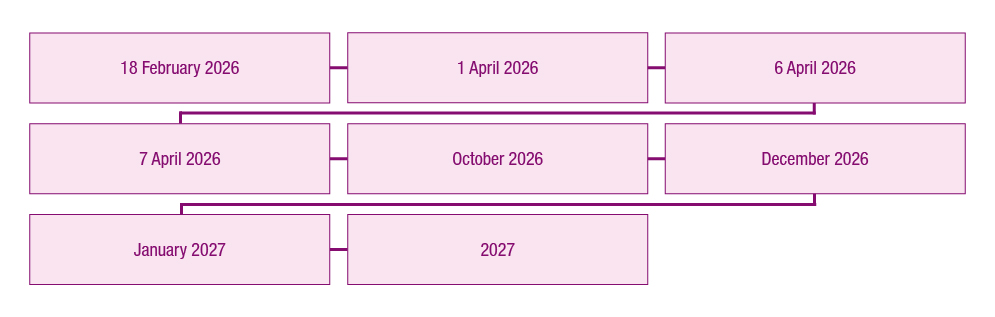
The most significant changes from the Employment Rights Act
The Employment Rights Act 2025 (ERA) introduces fundamental changes to employment law affecting all employers, strengthening employee entitlements, expanding protections and increasing the compliance requirements of organisations. Key reforms this year include wider access to statutory sick pay, new day‑one family leave rights, and far greater duties to prevent harassment in the workplace, including protection from third‑party harassment. An extension to time limits for employment tribunal claims is scheduled at the earliest for October 2026. A new regulatory and enforcement body, the Fair Work Agency will be responsible for enforcing the national minimum wage, holiday pay and statutory sick pay. Employers also face increased collective obligations through easier union recognition, union access rights and a requirement to inform employees of their right to join a trade union.
Looking ahead to 2027, unfair dismissal protection will apply after just six months with the cap on compensatory awards removed, and new restrictions on zero‑hours contracts will require guaranteed hours and more predictable shift scheduling. Fire and rehire practices and flexible working refusals will be more tightly regulated. Larger employers will also move to mandatory gender pay gap and menopause action plans.
Together, these changes signal a shift towards earlier and stronger employee rights and greater accountability for employers across all sectors.
What Changes Take Effect in April 2026?
April 2026 marks the first major milestone in the rollout of the Employment Rights Act 2025 for most employers. This phase brings a series of reforms that strengthen ‘day 1’ rights and increase protections across the workforce.
From early April, employers will see several important developments. New day one rights to paternity and unpaid parental leave apply, and statutory sick pay rules change so more individuals qualify and qualify sooner. The maximum protective award for failure to properly inform and consult in collective redundancy situations doubles, increasing potential exposure for non-compliance. This phase introduces the new Fair Work Agency, an enforcement body designed to support and uphold employment rights including the national minimum wage, holiday pay and statutory sick pay. Not keeping adequate holiday entitlement and pay records will become a criminal offence. There are changes to simplify the trade union recognition process, reflecting the Government’s wider intention to give unions a stronger voice in the workplace.
There is also a change to how concerns about sexual harassment in the workplace must be handled. Disclosures relating to sexual harassment will have the potential to qualify as a statutory protected whistleblowing complaint. This gives individuals raising such concerns stronger legal protections and places an increased emphasis on employers handling complaints carefully, consistently and in a way that demonstrates a clear and robust process.
Larger employers with 250 or more employees are being encouraged from April 2026 to introduce voluntary Equality Action Plans covering gender equality and menopause support, ahead of these becoming compulsory in 2027. Initial Government guidance confirms that these plans will need to set out evidence‑based actions to improve gender equality and menopause support and a list of recommended actions has been published online. Although smaller organisations are not required to publish Equality Action Plans, employee expectations of all employers in these areas are likely to increase.
What Changes Take Effect in or from October 2026?
A second wave of major reforms under the Employment Rights Act 2025 will take effect from October 2026, introducing further obligations that strengthen employee protections and expand employer responsibilities.
One of the most significant developments is the strengthened duties to prevent work-related harassment. The law will move from requiring employers to take “reasonable steps” to requiring them to show they took “all reasonable steps” to prevent sexual harassment of their employees. In addition, employers will become liable for harassment carried out by third parties, such as customers, clients, suppliers. These changes will require employers to review their policies, training, and reporting processes to ensure they can meet the higher standards.
October 2026 also introduces changes to tipping practices, which is relevant for hospitality, leisure and tourism sectors. The existing 2024 tipping rules are being tightened, with a new requirement for employers to consult workers or their representatives when creating or reviewing their tips policy, both for the first version and future reviews.
There are further reforms affecting trade union rights. From October, unions will gain a statutory right to access workplaces, physically and digitally, for recruitment, organising and collective bargaining, including in workplaces where they are not currently recognised. Employers will also have a new duty to inform new workers in a written statement at the start of their employment (and at other times during employment to be confirmed) that they have the right to join a trade union.
Time limits for most employment tribunal claims are expected to extend from three months to six months. This will apply to all claim types, including discrimination and unfair dismissal, other than breach of contract claims, and will require employers to manage claim documentation and internal processes over a longer period.
What Changes Take Effect in or from 2027?
From 2027, the ERA 2025 brings some of the most significant shifts for employers, particularly around unfair dismissal claim risks, job security issues for zero hours workers and family‑related rights.
From 1 January 2027, unfair dismissal protection will reduce from a qualifying period of two years down to six months’ service instead. This is a major change that brings forward the point at which employers must justify a dismissal as being fair by 18 months. At the same time, the cap on the compensatory award will be removed. The financial limit of £123,543 (from 6 April 2026) or 52 weeks’ gross pay will fall away, meaning compensation will reflect an employee’s actual financial loss and could potentially be much higher.
Significant restrictions on fire‑and‑rehire will take effect in January 2027. Dismissals used to impose changes to key terms such as pay, hours, pensions, shift patterns and time‑off rights, will be automatically unfair if an employee is dismissed for not agreeing a change or the employer wished to employ another person on the varied terms, but for substantially the same job. The new restrictions will also cover the practice of “fire and replace”, i.e. where an employees are dismissed and replaced with self-employed contractors, agency workers or other non‑employees on less favourable terms and conditions of engagement. The new fire and rehire protections will be subject to limited exceptions for genuine financial distress.
Other changes that will take effect during 2027 include working‑pattern reforms for zero hours, “low hours” and agency worker contracts. Employers must offer qualifying workers a contract that reflects the actual hours they regularly work over a reference period, which is likely to be 12 weeks. Workers will gain the right to reasonable notice of shifts, and compensation will be required for short‑notice changes or cancellations.
Flexible working rights will continue to strengthen for employees. Refusals will need meet a new requirement of employers setting out the grounds for refusal and why they consider them reasonable. The Government is consulting on a light touch process that employers must follow when they are considering not accepting a flexible working request, which may include a meeting, consultation and a written outcome of the discussion.
Family‑related protections will expand, with the Government empowered to restrict dismissals during pregnancy, maternity leave and the return period. There are already protections in place for maternity returners in redundancy situations, which may widen to other types of dismissals. The extended protection will also apply to adoption leave, shared parental leave, neonatal care leave and bereaved partners’ paternity leave. A new day one right to at least one week of unpaid bereavement leave will be introduced, including for pregnancy loss before 24 weeks of pregnancy.
Action Plans on gender equality and menopause support will become mandatory for employers with 250 or more employees from 2027, building on the voluntary plans encouraged from April 2026.
The Act also begins the process of regulating umbrella companies by bringing them into a new oversight framework, with further measures expected following a Government consultation. An umbrella company typically employs workers on behalf of a recruitment agency or end user client.
Policies, Contracts and Payroll: Priority Updates to Make Now
The Employment Rights Act 2025 brings several early reforms that require employers to update their contracts, handbooks and payroll processes now for changes taking effect from April 2026. The most immediate changes relate to day one statutory sick pay, day one statutory paternity and unpaid parental leave. Getting documentation and systems in order now will reduce risk, support compliance and ensure managers can apply the changes consistently.
With statutory sick pay (SSP) applying immediately, with no waiting days and no lower earnings limit, payroll systems must be configured to apply SSP automatically from the first day of absence and must calculate SSP correctly for lower‑earning staff using the new approach. Sickness policies, self‑certification forms and reporting processes should be revised to reflect these rules and to support consistent decision‑making. Employers should also ensure managers are prepared to handle questions about eligibility and a potential rise in short‑notice absences.
Family leave policies and employment contracts need careful review. With paternity leave and unpaid parental leave becoming day one rights, policies and procedures should be updated to remove old service thresholds and must make clear that new starters can exercise these family leave rights immediately. Where enhanced company sick pay, paternity or parental leave and pay already exist in a workplace, this should be reviewed and policies may need to be updated to make clear how enhanced arrangements interact with statutory day one entitlements.
The introduction of the new Fair Work Agency in April 2026 with broad interventionist powers will bring together the enforcement of existing employee rights and employer obligations including the national minimum wage, statutory sick pay, employment agencies, modern slavery, labour exploitation and employment tribunal penalties. There will be new state enforcement of holiday pay and a requirement for employers to keep adequate records of holiday pay and entitlement. Employers should maintain well organised records reflecting compliance including with the national minimum wage, statutory sick pay and holiday pay.
With a view to other changes taking place in April and October 2026, employers should ensure their equality, anti-harassment, and whistleblowing policies are aligned with upcoming reforms. In particular, the increased protection for sexual‑harassment whistle-blowing disclosures, a requirement for employers to take “all reasonable steps” to prevent sexual harassment of their employees and an obligation not to permit harassment of their employees by third parties.
Managing Absence and Leave Requests: Processes That Stand Up to Scrutiny
The change to eligibility on day one of employment from 6 April 2026 for statutory sick pay, paternity leave and unpaid parental leave, means employers must review their absence and family leave processes to ensure they are legally compliant and consistent. With more employees qualifying and with leave notices for paternity leave and unpaid parental leave having been capable of being submitted from 18 February 2026, employers need clear procedures that managers can follow.
Focussing on the new requirements for sickness‑absence reporting is a priority for employers. Statutory sick pay will apply from day one of absence, with no waiting days and no lower earnings limit (previously £125 per week). Employers must update sickness absence reporting requirements, self‑certification processes and payroll triggers. Managers should be instructed to hold early conversations about frequent short-term absences, which is an area likely to increase for some employers. Accurate record‑keeping is essential bearing in mind informal practices can lead to inconsistent decisions.
For paternity and unpaid parental leave, employers must change processes around the removal of all qualifying service requirements. From 6 April 2026, new starters may request this leave immediately, so processing by employers must be simple, well‑communicated and applied consistently. Employers should set out clear steps for managers on how to respond to a request, evidence requirements, the timeframe for responding, and coordinating requests with HR and payroll.
Record‑keeping for employers is critical, now even more so from 7 April 2026. The new Fair Work Agency established on that date will have powers to inspect employer records relating to the national minimum wage, statutory sick pay and holiday pay and can issue penalties for non‑compliance. Employers should therefore keep accurate and up‑to‑date records of hours worked and paid, statutory sick pay, holiday entitlement and holiday pay.
With day one rights and greater protections in force, legally compliant, robust processes are not optional. By strengthening guidance and documentation now, employers can ensure they are ready to manage absence and leave fairly and confidently as the ERA reforms take effect.
Recruitment, Probationary Periods and Dismissals
The Government has stepped back from its earlier flagship proposal for day one unfair dismissal rights, meaning the familiar employment law framework will largely remain in place. But the reforms that are going ahead still represent a dramatic shift and they matter immediately. Every employee with at least six months’ service on 1 January 2027 will gain unfair dismissal protection on that date. In practice, that gives employers just six months to assess the performance of anyone hired from 1 July this year before they acquire unfair dismissal rights.
It will be all too easy for employers to let time slip by and not proactively deal with new recruits soon enough before they qualify for unfair dismissal rights significantly earlier. Consider this scenario: you hire someone on 1 April with a six‑month probationary period, ending on 30 September. Their manager extends probation by three months to the end of December. The business closes over Christmas. By 1 January, the employee has nine months’ service and full unfair dismissal protection. To dismiss fairly after that point, an employer will need to follow a full formal performance management process.
Steps need to be taken now to plan for the shorter qualifying period. Employers should review the length of probationary periods and consider reducing them. Three months is advisable because it gives scope to extend and provides scope if managers act late. If probationary periods are reduced, template contracts, offer letters and manager guidance will need updating.
Underperformance at work should be dealt with now. Employees with less than two years’ service who will have at least six months by 1 January should be managed proactively during 2026. Recruitment processes may also need attention, with sensible steps including more stringent interviews, tests or vetting to reduce the risk of unsuitable hires. Processes for assessing new hires should be tightened, with clear targets, regular feedback and a firm timetable for deciding whether to pass or fail an employee on a probationary period.
At the same time on 1 January 2027, the cap on the compensatory award for successful unfair dismissal claims will be removed. The financial limit of £123,543 (from 6 April 2026) or 52 weeks’ gross pay will fall away, so compensation will instead reflect an employee’s actual financial loss and could in some cases be significantly higher. So, if a staff member is underperforming, now is the appropriate moment to engage with that. Once the new regime applies in January, employers must use the full performance management process for staff who qualify for unfair dismissal rights or risk a successful claim, which may make any exit discussions more formal and potentially more expensive.
Collective Redundancies Restructuring and Trade Unions: New and Heightened Risks
The Employment Rights Act 2025 (ERA) introduces several reforms that significantly increase employer risk when handling restructuring, collective redundancies and trade union engagement. These changes require employers to adopt more structured processes, plan earlier and maintain clearer documentation capable of withstanding tribunal and regulatory scrutiny.
One of the most significant shifts is the doubling of the maximum protective award for failures in collective redundancy consultation from 90 to 180 days’ pay per affected employee from early April 2026. This substantially raises the financial consequences where 20 or more redundancies (or contractual changes that fall under collective redundancy legislation) are proposed within a 90‑day period. Employers will need more careful planning, earlier election and engagement with employee representatives or unions (as applicable), and clear evidence of meaningful consultation. Rushed processes or informal communication that cannot be substantiated will carry far greater risk.
The ERA is due to introduce a new organisation‑wide threshold for collective consultation, requiring employers to count redundancies across the whole business, not just at a single establishment, when deciding whether the 20 employee threshold is met. Consultation is underway, with the preferred approach being a fixed number of company‑wide redundancies between 250 and 1,000 triggering the duty, with changes expected in 2027.
From April 2026, simpler union recognition rules will make statutory recognition easier to secure. With the thresholds for union membership and support set to reduce, and turnout requirements being removed, more employers may find themselves facing recognition applications even where they have not previously experienced union activity. From October 2026, unions will also gain a statutory right to access workplaces, both physically and digitally, for recruitment, organising and collective bargaining. Employers will need internal protocols for handling access requests, documented decisions and clear manager guidance, as access cannot be unreasonably refused. A new duty to inform workers of their right to join a trade union is also due to become mandatory from October 2026
Finally, substantial restrictions on fire and rehire take effect in January 2027, making it automatically unfair to dismiss an employee for refusing changes to core contractual terms. Fire and replace practices will also be prohibited. Only narrow exceptions for preventing or reducing financial difficulties affecting viability will remain.
Training, Communication and Governance: Evidencing Compliance
As the Employment Rights Act 2025 (ERA) reforms begin to take effect, employers will need clear, demonstrable systems for training, communication and record keeping to show compliance to the new Fair Work Agency and, where necessary, to employment tribunals. Employers must understand the ERA changes, know how to apply them consistently, and recognise where everyday interactions, such as absence management, leave requests or behavioural concerns, now carry increased legal risk.
Manager training should focus on the practical day‑to‑day implications of the reforms. This includes early and confident conversations about sickness absence under day one statutory sick pay, handling paternity and parental leave requests from new starters, responding to flexible working requests, implementing contractual changes, understanding harassment prevention duties, and identifying when a concern may amount to a sexual harassment related whistleblowing disclosure. Employers should provide simple, repeatable tools: checklists, template scripts, escalation routes and clear guidance on documentation. Managers must understand the importance of consistency, documentation and early communication, and know when to seek HR or legal support.
Workforce communication must be straightforward and proactive. Clear, accessible policies covering harassment prevention, whistleblowing, flexible working, absence management, family leave, recruitment, probation and dismissal help ensure employees understand their rights from day one and know how to report concerns.
Record keeping is critical. Employers should keep accurate and up‑to‑date records of hours worked, statutory payment calculations, leave and flexible working requests, sickness reporting and investigation notes. This becomes even more important as the new Fair Work Agency established in April 2026, has powers to inspect employer records relating to the national minimum wage, statutory sick pay and holiday pay, and can issue penalties for non‑compliance. In addition, tribunal time limits are due to extend from three to six months from October 2026 for most claims
The ERA introduces a strengthened duty to take all reasonable steps to prevent sexual harassment from October 2026. The requirement to have taken all reasonable preventative steps will also apply when harassment (not just on grounds of sexual harassment) is carried out by third parties such as customers, clients or suppliers. Claims will become harder to defend if employers cannot evidence pro-active steps have been taken. Updating anti-harassment policies, demonstrating practical training has occurred, risk‑assessing working environments, strengthening reporting channels and robust complaint handling will be essential.
Alongside these measures, employers should put in place a clear ERA 2025 compliance plan for 2026–27. Mapping legislative milestones, breaking down actions by phase, scheduling regular checkpoints and allocating responsibilities ensures reforms are implemented consistently and on time. Integrating communication and training into this timetable supports good governance and provides a clear audit trail capable of demonstrating compliance to regulatory bodies and employment tribunals.
If wishing to discuss this further please get in contact with Laura McFadyen in our Employment team or call us on 0345 540 5558.