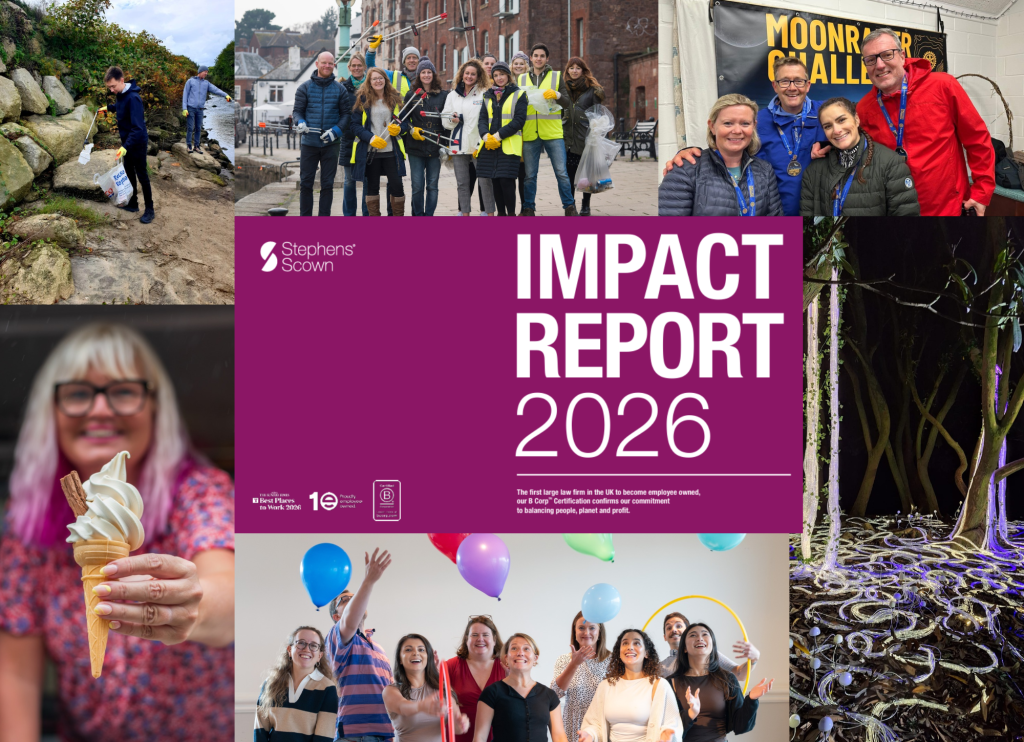
2026 marked an important milestone for regional heavyweight law firm Stephens Scown, which achieved B Corp recertification four years after first becoming certified in 2022. Its B Impact Assessment score increased from 90.4 to 105, reflecting progress across all five impact areas: Governance, Workers, Community, Environment and Customers. Its latest Impact Report looks back at that progress and sets out the firm’s ambitions for the year ahead.
Purpose in practice
At Stephens Scown, purpose is more than a statement of intent. It is embedded into the way we operate, from our employee ownership model and B Corp Certification to the advice we provide to clients and the impact we seek to generate in our communities. We believe that, through doing things differently, we can be a catalyst for positive change.
Our increased B Impact Assessment score reflects progress made across each area: Governance, Workers, Community, Environment, and Customers. The largest gains were achieved in the Community and Environment sections, recognising our investment in volunteering, charitable giving, our sustainability ambitions, and achieving operational Net Zero.
The publication of an impact report is part of the B Corp certification requirement. It highlights work done over the preceding 12 months, and goals for the next 12 months. The report provides transparency around the firm’s impact, holding it accountable for progress made while setting out where further improvement is needed.
As the instigator of the firm’s initial push to accreditation, Verity Slater, Partner in the Employment and Immigration team said of the latest report, “This year has seen real progress, reflected in our higher assessment score and the collective effort that went into securing recertification. Doing good and having a positive impact is part of who we are, and increasingly something people tell us matters when they choose to join the firm.
“There will always be more we can do. Each year brings new challenges, and our focus now is on continuing to make meaningful progress across every area of the assessment.”
Managing Partner Richard Baker added, “Our commitment to doing good for our people, our communities and the environment is an important part of our culture and how we run the business. Improving our B Corp score is encouraging, but what matters is continuing to make tangible progress and using what we learn to help clients with their own ambitions.”
Progress across the firm
With continued investment in the workplace, the firm was once more named on the list of the Sunday Times Best Places to Work, maintaining or improving scores across the six pillars measured; Job Satisfaction, Instilling Pride, Empowerment, Information Sharing, Wellbeing, and Rewards & Recognition.
A newly launched Careers Pathway project improved transparency, progression and access to opportunity across the firm, including the creation of a Senior Paralegal role and a review of legal support job titles.
The firm was Highly Commended in the Law Firm of the Year category on a national stage at the Clio Modern Law Awards, before securing a prize for UK Impact Case of the Year at the Managing IP Awards for its work on the Thatchers v Aldi case. Stephens Scown was also named Law Firm of the Year and Employer of the Year at the Devon and Somerset Law Society Awards.
Community impact
Volunteering across the last year increased to 34% of all Scowners, as participation is encouraged as part of annual appraisals. Collectively, it amounted to 1,033 hours of work in the local community. Efforts included litter picking and beach cleaning, charity collections, work at local animal shelters and zoos, and food donations.
Pro bono work last year included advising on the structure and governance in launching Peter Shiltons’ anti-gambling charity Shiltons’ Silverlining, leasing arrangements for a community farm, employment support for a local rugby club, and work with a local community foundation.
Charity events in support of office charities Fear Free (Exeter), Cornwall Hospice Care (Truro), Open Door (Taunton), and Children’s Hospice South West (firmwide) saw almost £13,000 raised to support their work.
Reducing our environmental impact
December 2025 saw the firm become operationally Net Zero, delivering on a commitment first made in 2020. Procuring renewable electricity, work to make offices more energy efficient and a transition away from gas heating technologies contributed to achieving the goal. Offsetting the small residual balance came thanks to supporting high-quality carbon removal projects in Nicaraguan rainforests via the Norteak Group, and tree planting in Cornwall with Plant One.
Achieving Operational Net Zero does not mean the work stops. The Firm remains focused on reducing its carbon footprint further, including introducing more EV chargers, encouraging car sharing and reducing waste, while all its sites now use 100% renewable energy.
Over the coming year we will continue to strengthen our approach in line with the evolving B Corp standards, with our latest report available to view here. Stephens Scown remains committed to proving that profitable business can be a force for good.