
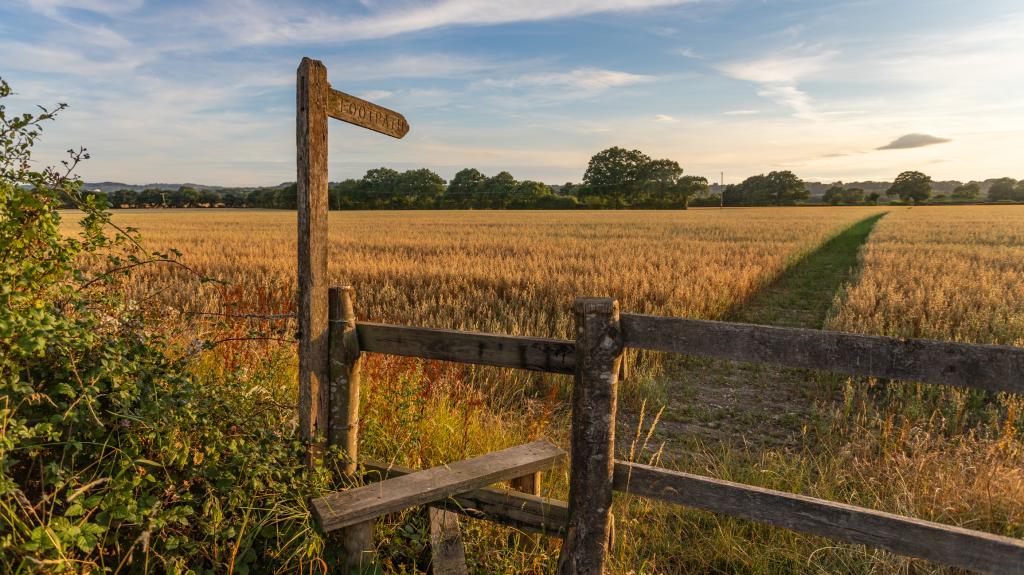
A public footpath or bridleway across private land can quickly become more than a minor inconvenience. It may affect privacy, security, livestock, development plans or the way land is managed each day. Moving or closing a route is possible, but only where the right evidence is gathered, the correct process is followed and the public impact is properly addressed from the outset.
What is a Public Footpath and who has Rights Over it?
A public footpath is a type of public right of way – a legally protected route over land that the public can use. Public footpaths are typically for walking or running, whilst bridleways are open to riders and cyclists too.
Public rights of way are protected to preserve public access; rural routes enable access to the countryside and support recreation, whilst more urban routes can be used for commuting. Many routes have historic origins, for example a miners route to the pub after work, or the path the village traditionally walked to church every Sunday.
Although many routes were created through historic use, once a public right of way has been established it exists forever unless it is lawfully diverted or extinguished. This can create tension with modern land use. Issues such as littering, dogs near livestock, security concerns or a loss of privacy will remain unless the route is changed through the correct legal process.
Can I Legally Move or Close a Public Footpath?
Fortunately, it is possible to apply to move or close a public footpath or bridleway.
The principle test for any proposed diversion is whether the new route would be ‘substantially less convenient’ to the public than the original route. Convenience is a subjective measure, but this is typically measured in length of the route and its accessibility – is the proposed diversion longer or more difficult than the current route? The decision maker shall also consider the effect the proposed diversion would have on ‘public enjoyment’ of the route. Again, this is subjective, but often includes consideration of landscape views and the atmosphere of the route – does the proposed diversion have the same feel as the original route?
More objective matters are also considered, such as how the proposed diversion will link into the wider highway network, or the impact the diversion route will have on the land it is proposed to occupy.
It is also possible to apply to close or extinguish a footpath or bridleway. Here the question is whether the public right of way is not needed for public use – a very high bar that is rarely satisfied. Nevertheless, if a suitable alternative route exists or the route is a dead-end a landowner can consider whether to apply to have the path closed.
Whilst the impact of the public right of way on the landowner is considered in these applications, this is not a determinative test. An application that requests a path is moved or closed purely for the convenience of the landowner is unlikely to succeed. A well-constructed application will explain how the benefits to the landowner will also benefit the public.
What is the Process for Applying to Divert a Footpath?
In the first instance, an application to move or close a footpath or bridleway is made to the local highway authority. Each local highway authority processes these applications in different ways, and it will be necessary to tailor your application to the requirements of your local highway authority.
If the local highway authority supports the application but it receives objections, it will be referred to the Planning Inspectorate, the government body that determines these applications on behalf of the Secretary of State.
What Challenges or Objections Might I Face During this Process?
It is a regular occurrence that applications to move or close a public right of way receive objections. These can be from local users, the parish council, or user groups such as the Ramblers or Open Spaces Society.
Whilst objections can prompt referral to the Planning Inspectorate and delay the process, they are not always a significant threat to the application. Objections made on irrelevant grounds – for example a personal connection to the original route – are likely to be dismissed, whilst objections that relate to the legal tests should have been pre-empted when drafting the application.
At all levels, public rights of way teams lack resources to process applications promptly. Potential applicants should be prepared for the process to take several years to complete.
Why is Legal Advice Essential when Dealing with Public Footpaths?
If you are considering moving a public of right of way, early professional advice is invaluable. The statutory tests are strict, the evidence must be carefully prepared, and the process can take considerable time. Legal advice can help identify the correct route, assess the strength of an application before costs are incurred, anticipate likely objections, and present the proposal in a way that addresses both the relevant legal tests and the practical concerns of the local highway authority or Planning Inspectorate.
This article was written by Oliver Bradbear, Solicitor in our Planning team.