
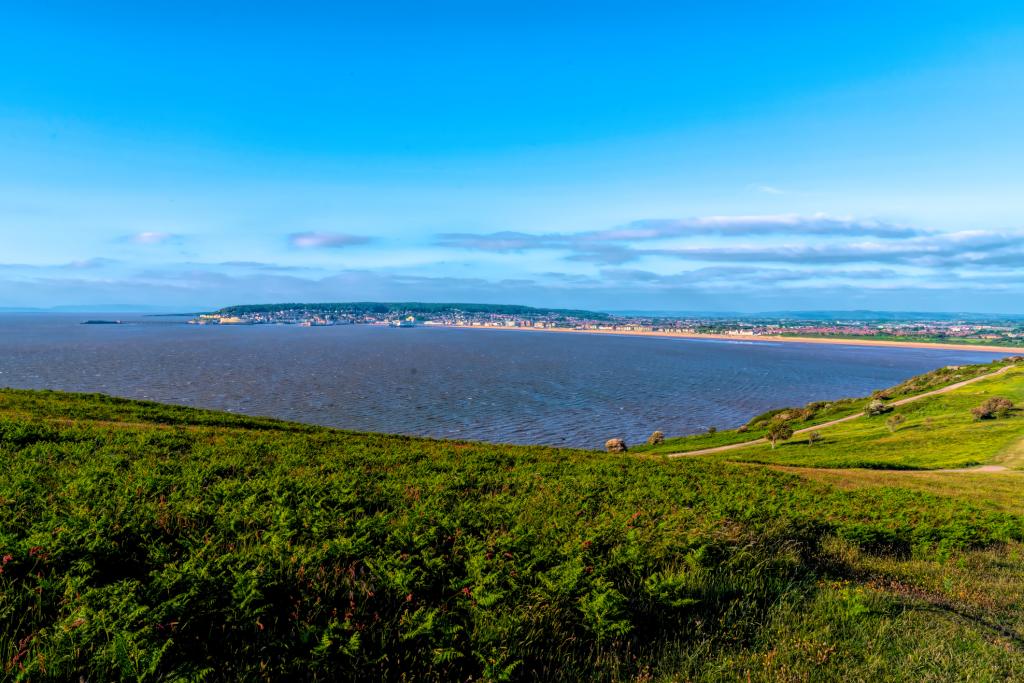
The West Somerset Tidal Lagoon has been in the news again, with the Guardian recently publishing an article on how the proposed tidal power station off the Somerset coast could help harness energy for the predicted AI boom. This has led to renewed discourse by local communities to the proposed development, as to what the scheme can deliver to the local community by way of true investment and jobs.
What is it?
The West Somerset Tidal Lagoon is a proposed Tidal Range power scheme. It aims to harness the energy of the tides to provide reliable, predictable, renewable energy, by taking advantage of the second highest tidal range in the world (over 10m).
As well as producing renewable energy, the lagoon could also include interactive elements for visitors, which have been incorporated with the aim of boosting Minehead’s economy. These include a path on top of the barrage for walkers and cyclists, a water-sports marina, a lido and an observation tower. There are also hopes that the development could play home to oyster and mussel beds, arrays of floating solar panels and a coastal amphitheatre.
Where would it be based?
The West Somerset Tidal Lagoon would be located on the southern coast of the Bristol Channel Basin between Minehead and Watchet.
The location of the lagoon would mean that it would be:
- Outside the navigation channel to Bristol and South Wales Ports
- Outside of Special Areas of Conservation, Special Protection Areas and Local Nature Reserves
- No major rivers will be enclosed; and
- It will provide coastal protection against storms and sea level rise to 14km of coast.
How does it work?
An enclosure is formed to impound the tides. The tides, which are powered by the moon, flow in and out of the lagoon’s 125 turbines to generate electrical energy, producing four periods of energy every 24 hours.
At the end of each generation cycle, large sluice gates are opened to allow more water into the lagoon to increase water level and energy in the next generation cycle.
The scheme at maximum output would be enough to power 2 million homes.
Proposed benefits and reservations
In terms of benefits, the consortium claims that the development will create skilled full-time jobs, an area for water-sports, a lido, a visitor’s centre, and observation tower and cultural facilities. It could also become a hub for marine farming mussels, seaweed and oysters.
There would be locks within the lagoon structure at Minehead and Watchet, allowing the towns’ harbours to stay open to commercial ships and leisure crafts.
It is also a proven technology, with La Rance Tidal Power Station in Brittany, France completed in 1967, which has now operated for nearly 60 years.
In terms of reservations to the proposed scheme, critics argue that such a project may not actually be viable, citing other previous infrastructure projects which have left Councils out of pocket, as well as fears that pursuing such largescale novel developments diverts focus from the immediate needs of local residents, such as improving current transport links and existing jobs.
The role of tidal renewable energy in government policy
The Department for Energy Security & Net Zero (‘DESNZ’) published its ‘Overarching National Policy Statement for Energy (EN-1)’ in December 2025.
With DESNZ predicting that the demand for electricity is likely to increase significantly over the coming years and could more than double by 2050, it is important that the UK needs a diverse mix of electricity infrastructure to come forward, so that the UK can deliver a secure, reliable, affordable and net zero consistent system during the transition to 2030 and 2050 for a wide range of demand, decarbonisation, and technology scenarios.
DESNZ recognise that tidal power (as with most other renewable sources), could help provide security of supply, and would help diversify the UK’s current energy mix. However, it is not a silver bullet.
Due to the constraints in location as to where tidal lagoons can be installed (the topography has to be correct in order for them to work, which limits the locations in which they can be installed), total capacity is limited for tidal power, and DESNZ recognise that this technology alone cannot meet the UK’s energy objectives.
The Guardian obtained a statement from a spokesperson from DESNZ in its 27 December 2025 article as follows:
“We are open to considering a well-developed proposals for harnessing the tidal range energy in the bays and estuaries around our coastlines, which demonstrate strong value for money.”
Concluding remarks
Once again, Somerset is on the map in terms of its largescale clean energy production capabilities.
With the West Somerset Tidal Lagoon currently seeking to raise funding and undertake preliminary studies throughout 2026, it will be interesting to follow it’s journey this year and beyond.
Kate Evans is a senior associate in Stephens Scown’s Construction team. Kate specialises in largescale industrial decarbonisation and renewable energy projects.